Sustainable Farming Practices: A Contribution from Microgreens at Lightfoot's Farm, New Forest, Sway
Updated: Sep 8
There's a lot of loose "sustainable" talk in food marketing, so it's worth actually checking the numbers and understanding the particular contribution rather than asking you to take our word for it or thinking there is a 'silver bullet' vs the need for a systems strategy which is in fact essential for sustainability.
At Lightfoot's Farm, we have as a baseline for our sustainable food production target that we produce at a level which would provide enough food for all of the UK if all of the UK's agricultural land was managed this way. We consider it our responsibility to find sustainable ways to grow rather than to 'export' the environmental challenge to other countries and 'pretend' that simply rewilding the UK's land is an environmental net positive.
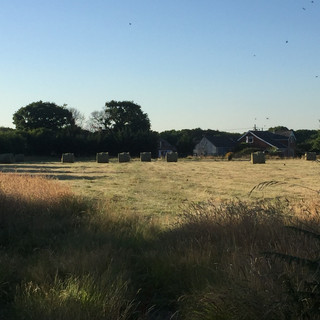
Whilst our land here at Lightfoot's in the New Forest is considered 'low value' agricultural land and would typically be permanent grassland for notoriously inefficient meat production grassland accounts for around 72% of all UK's agricultural land¹ - we achieve our goals by utilising the highly productive techniques of a vertical farm which relieves pressure on our outside land, which we then allocate more extensively to primarily perennial production - far more efficient than animals for food.

Our small 'controlled environment' agricultural space can produce nutritional intake needs of around 80 people, regardless of what climate change challenges outdoor growing faces - and locally - regardless of what geopolitical supply chain disruptions might occur. It's not without its challenges, and provides a portion of our needs not all, but it's a strong, resilient, and substantial contribution, and it relieves pressure on outdoor growing that enables us to be more sustainable with our growing outside too, giving space for organic, biodiverse growing, as well as access for people through our glamping enterprise which we also see as an important sustainability contribution of land which people need connection to.

A notable sustainability benefit of microgreens in controlled agriculture is its water use efficiency, and its reliable year-round local production. A standard tray of microgreens (yielding around 250-275g) uses roughly 2-4 litres across its whole growing cycle - around 11-12 litres for every kilogram produced. Compare that to around 285 litres per kilogram for field-grown broccoli, based on published water-footprint research². And it's genuinely local - most of what leaves our farm gate travels a few miles on our own delivery round - today's round for example averaged 1.8 miles per drop, compared to around 224 miles for a typical mass-distribution box scheme³.
With flooding winters and drought summers, the benefits of this system can represent a huge difference. Worked through properly, that's something like 95-96% less water for the same weight of food.
The rest follows the same logic, without pesticides, without the plough. A 7-14 day growing cycle from seed to harvest means there's no energy or soil damage done, and no time for the pest and disease pressure that field crops build up over a full season, so we don't need any artificial inputs. Because we grow indoors, in Sway, on a controlled rack system, the same tray produces food whatever the weather's doing outside - no ploughing, no bare soil exposed to wind and rain, no diesel for field machinery, no geopolitical risk of supply disruption.
None of this means microgreens replace a balanced diet of field-grown veg, which offer different benefits - they are a polyphenol rich, gut-health, nutrient-dense addition, not the whole answer. But pound for pound, they're one of the lowest-footprint, fresh, tasty and nutritious foods you can put on a plate - the prized 'growing tip' of the plant where all the nutrition accumulates, and now you've got the actual numbers behind that claim, not just our word for it.
¹ Defra (2025), Agriculture in the United Kingdom 2025, Chapter 2: Structure of Industry. Permanent grassland: 9.48 million hectares of 17.97 million hectares total UK agricultural land.
² Water-footprint comparison calculated from Mekonnen & Hoekstra water footprint data (Water Footprint Network), via On The Grow.
³ Coley, D., Howard, M., & Winter, M. (2009). Local food, food miles and carbon emissions: A comparison of farm shop and mass distribution approaches. Food Policy, 34(2), 150–155.


Comments